

The writing section of the TELC B1 German exam often feels intimidating for learners. You only have 30 minutes to write a short letter (100–120 words) that must show not just correct grammar, but also clear communication and a bit of "advanced" language.
The good news? With the right strategies, you can turn this into one of your strongest parts of the exam.
What to Expect in the TELC B1 Writing Task
- You will always be asked to write an informal letter or email.
- The task usually includes 4 points you must cover in your answer.
- Typical topics: invitations, visits, personal news, hobbies, or daily life.
Here is a real example — a free B1CLASS exercise. Try it right here:
How the Writing Is Scored
Examiners usually evaluate based on three main categories:
-
Content / Task Fulfillment
Did you answer all the points from the task? Is the letter appropriate for the situation? -
Communication / Structure
Is your text easy to follow? Does it have a beginning, middle, and end? Does it sound natural? -
Accuracy / Grammar & Vocabulary
Do you use correct grammar and spelling? Do you show some variety with vocabulary and sentence structures?
Smart Strategies for a High Score
1. Memorize a Flexible Structure
Here's a structure you can use for nearly every writing task:
-
Betreff (Subject line)
One short sentence summarizing the letter. Tip: A "zu + Infinitiv" structure works well here.- Example: "Tipps zur Führerscheinprüfung geben"
-
Anrede (Greeting)
Lieber Paul, / Liebe Anna, -
Einleitung (Introduction)
Start friendly. Combine a standard opener with a prepared sentence that shows B1 grammar.- Danke für deinen Brief, ich habe mich sehr gefreut.
- Bei mir gibt es auch Neuigkeiten: Die Wohnung meiner Schwester liegt im Zentrum der Stadt, und ihr Balkon hat eine wunderbare Aussicht.
-
Hauptteil (Main Part)
Answer all 4 points from the task. Use linking words (zuerst, außerdem, deshalb, obwohl, trotzdem). -
Schluss (Closing)
A short, warm line.- Ich freue mich schon auf unser Treffen.
-
Grußformel (Farewell)
Liebe Grüße, [Dein Name]
2. Master a Few Key Grammar Patterns
You don't need to use all B1 grammar. It's better to master a few powerful structures that impress examiners:
-
zu + Infinitiv
- Ich habe vor, im Sommer mehr Sport zu machen.
- This construction often works well in the Betreff (subject line) and can be useful in many writing tasks.
-
Obwohl / Trotzdem
- Obwohl ich müde war, habe ich weiter gelernt. Trotzdem habe ich die Prüfung bestanden.
-
One Genitiv sentence (adaptable to many topics)
- Bei mir gibt es auch Neuigkeiten: Der Balkon meiner Wohnung hat endlich neue Möbel, und ich genieße die Sonne dort jeden Tag.
3. Learn Reusable Phrases
About 20–30% of every letter can be memorized in advance. Examples:
-
Openers
- Danke für deinen Brief, es war schön von dir zu hören.
- Es tut mir leid, dass ich so lange nicht geschrieben habe.
-
Closings
- Schreib mir bitte bald zurück.
- Bis bald und liebe Grüße
This makes writing much easier on exam day.
4. Avoid Common Mistakes
- Don't forget to answer all 4 task points.
- Always keep the tone informal ("du").
- Don't write under 80 words or over 130.
- Double-check gender and case endings (mein Hund → meinen Hund).
How to Practice Effectively
The best way to improve is to practice under realistic exam conditions:
- 30 minutes per letter
- Stick to ~100–120 words
- Focus on using your "prepared" grammar and phrases
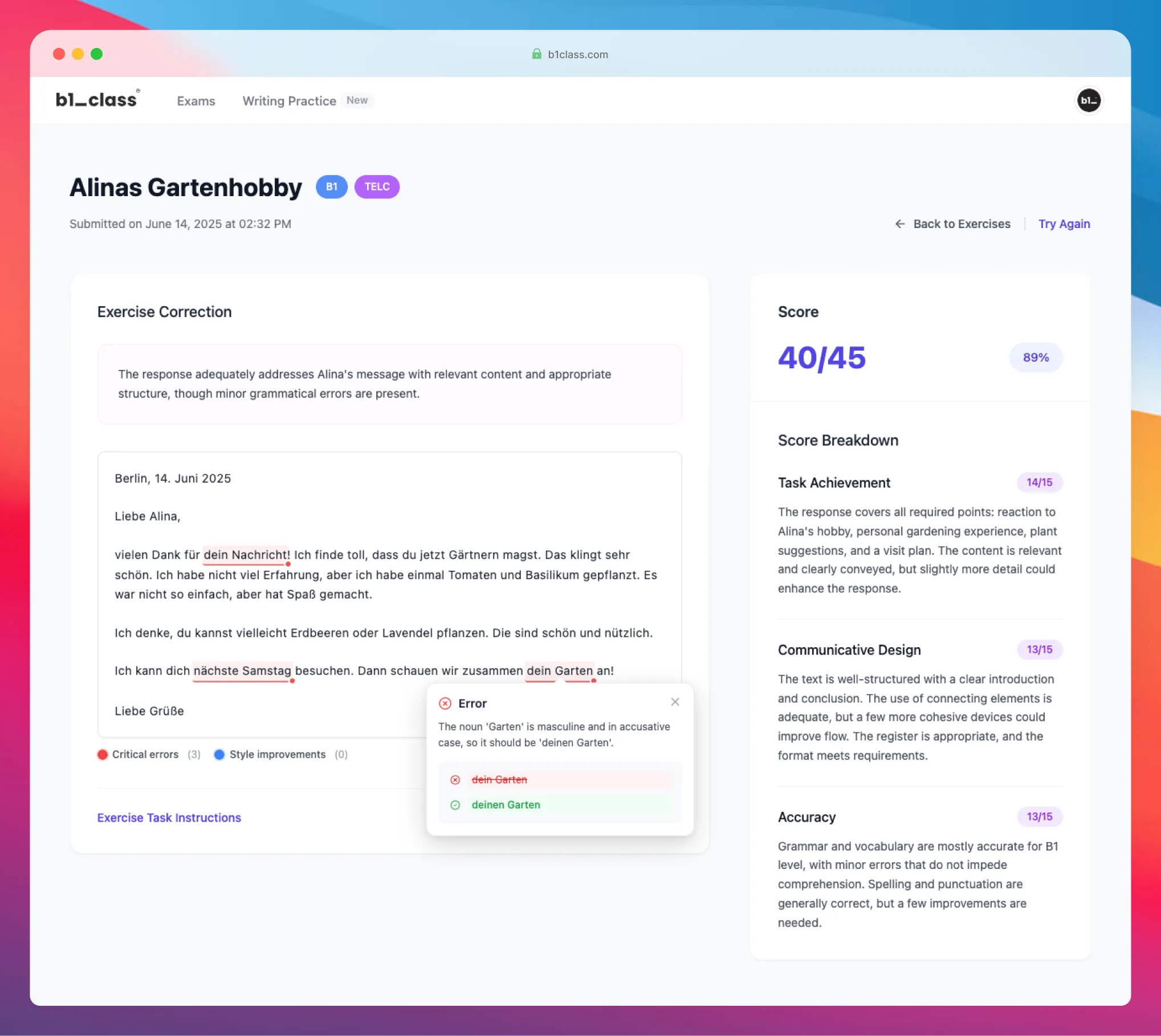
This is exactly what you can do with B1Class. We provide realistic writing tasks (like Paul's Führerschein letter) and our AI corrects your answers just like a TELC examiner would. You'll see corrections for grammar, vocabulary, and structure, plus an overall score.
This way, you don't just write, you learn from every attempt.
Here is what a corrected reply to Paul looks like — with the mistakes this guide warns about still in it. Click the underlined parts:
Final Tip: Practice, Don't Panic
The TELC B1 writing task is predictable. If you:
- Know the format
- Memorize useful structures and phrases
- Practice a handful of advanced grammar patterns
...then you'll walk into the exam confident and ready to impress the examiner.
Ready to try it out? Practice with realistic exercises and AI feedback on B1CLASS.com.